
About Revenge and Behavior
Your brain on revenge looks a lot like your brain on drugs. This blog post concerns revenge. It will help you understand the authoritarian mindset also and their use of revenge. It also deals with a way to g fix your own behavior with coping skills to treat the desire for revenge.
What is Revenge?
Revenge is an act designed to inflict harm on someone because they’ve inflicted harm on us. We could yearn for anything after we’ve been mistreated. However, what most of us really want is the other person’s pain. For them to know that their pain is because of the pain they’ve caused us.
The desire for revenge is the root motivation for almost all forms of human violence. From childhood bullying to intimate partner violence, urban violence, police brutality, mass shootings, violent extremism, genocide. During wars, perpetrators of violence almost always believe they’re victims seeking justice.
What neuroscience and psychology have found
Recent neuroscience discoveries reveal a chilling picture: Your brain on revenge looks like your brain on drugs. Brain imaging studies show that grievances—real or imagined perceptions of injustice, disrespect, betrayal, shame, or victimization—activate the “pain network,” specifically the anterior insula. The brain doesn’t like pain and tries to rebalance itself with pleasure. Pleasure can come from many things. Sadly, humans have evolved to feel intense pleasure from hurting the people who hurt us, or their proxies.
Research around the world
Over the past two decades, more than 60 neuroscientists at universities around the world have conducted brain scan studies demonstrating that when you’ve been wronged and begin to think about retaliating, the brain’s pleasure and reward circuitry of addiction awakens. The nucleus accumbens, associated with craving, and the dorsal striatum, associated with habit formation, spool up just as they do when drug addicts experience stress or see a place they connect with getting high.
A Persons Brain on Revenge
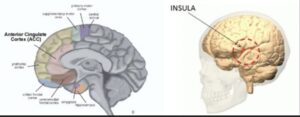
Dopamine levels appear to surge and crash, producing the familiar sensation of craving. Unlike other addictions, to gratify revenge cravings, you’ve got to hurt the people who hurt you (or, again, their proxies). When you do, you experience pleasure … for a while. Then, as with other addictions, the pain returns with a vengeance, leaving you feeling worse but wanting more. It may also expose you to the other person’s revenge cravings to hurt you, thus leaving a trail of wounded people in your wake.
About Dopamine, dopamine is often portrayed as the main chemical of pleasure, but the current opinion in pharmacology is that dopamine instead confers motivational salience. Motivational salience is a cognitive process and a form of attention that motivates or propels an individual’s behavior towards or away from a particular object, perceived event or outcome. In the brain, dopamine functions as a neurotransmitter, a chemical released by neurons (nerve cells) to send signals to other nerve cells. The brain includes several distinct dopamine pathways, one of which plays a major role in the motivational component of reward-motivated behavior. Therefore, a dopamine kick in revenge feels good.
So Who wants Revenge
Wanting revenge when you’ve been wronged is natural and is believed to have evolved as an adaptive strategy. Thus in modern societies, people often seek revenge for injuries like wounded egos that have little to do with survival or procreation. Two personality disorders love revenge. These are the borderline and Narcissistic personality disorders. Many authoritarian leaders are found to have Narcissistic personality disorders as part of the Dark Triad.
The prefrontal cortex, the area of your brain responsible for executive function and self-control. Therefore gets hijacked or inhibited with revenge emotions and the Dopamine pleasure kick. These people seek revenge for pleasure despite the negative consequences to themselves, and others, like the destruction of families, careers, other valuable relationships, and lastly the perpetration of psychological and physical violence.

The Definition of Addiction and History
That’s the common definition of addiction: the inability to resist powerful urges despite the negative consequences.
What does this compulsion look like throughout human history? In ancient times, Roman emperors staged public revenge spectacles in arenas and coliseums, feeding those who offended them or the state to wild beasts, forcing them to fight each other to the death as gladiators, and crucifying, incinerating, beheading, and scourging them for the pleasure of the cheering elite. During the Inquisition and witch hunts of the Middle Ages, aggrieved Christian leaders staged public revenge spectacles in villages and towns across Europe. They tortured and slaughtering alleged infidels, heretics, and sorcerers with the strappado, the rack, the wheel, and burning at the stake.
What History says about Revenge via Authoritarian leaders
In more modern times, Hitler, Stalin, and Mao achieved a combined death toll of some 102 million people by waging a world war that included murdering—or ordering or encouraging the murder, torture, or starvation of approximately 38.5 million people. They believed these people wronged them for things like betraying their nation (Jews in Germany) Hitler. Refusing to give up their land and possessions (peasants and landlords in communist Russia and China) Stalin and Mao. These leaders get inflamed when they feel disrespecting or have people opposing them (Putin and Trump).
By my estimate, of the top 20 human atrocities of all time, identified by researcher Matthew White in his book Atrocities: The 100 Deadliest Episodes in Human History, 19 were the result of compulsive revenge-seeking. They left an estimated 336 million people dead. We are currently seeing this in the war in Ukraine.
The Numbers who die each year!
These are enormous numbers, and they don’t include the daily acts of revenge-fueled violence humans experience, which lead to untold misery and loss of life. The World Health Organization estimates that violence-related injuries kill approximately 1.25 million people every year. According to the Centers for Disease Control’s National Violent Death Reporting System, the most common circumstance of violent death is “injury during an argument,” often in the pursuit of revenge to punish a real or imagined injustice. FBI and Secret Service studies and data show that most mass shooters are acting in accord with a personal grievance to achieve a measure of revenge.
Revenge – as a result of an addictive brain
By understanding the desire for revenge as the result of an addictive brain-biological process. Revenge is the primary motive for almost all forms of violence. Thus we can, for the first time in human history, develop evidence-based public health approaches to prevent and treat violence. On the prevention side, this might include things like school programs and public health campaigns to warn about the addictive dangers and risks of revenge use. On the treatment side, interventions could include revenge addiction counseling, cognitive behavioral therapy, peer support, self-help strategies, and one day, maybe even medications like the naltrexone and GLP-1 drugs (such as Ozempic) that have been shown to control compulsive cravings for food.
The fix for normal People
Neuroscientists have discovered a different, more potent and widely available remedy for revenge right inside our own brains: forgiveness. Researchers conduc
The coping skill of Forgiveness
Neuroscience shows us that forgiveness is a sort of wonder drug that stops pain, stops revenge craving, restores rational thinking. Thus, we develop better emotional intelligence from the wrongs and traumas of the past. On top of that, it’s free, available without a prescription. You can use forgiveness as often as needed to lessen your pain and prevent revenge fantasies whenever memories of a grievance return. There’s now scientific evidence supporting the ancient forgiveness teachings of Jesus and the Buddha.
More on the coping skill of Forgiveness
Forgiveness is a form of self-healing that benefits victims, but not the perpetrators. You can do it without being forced to accept or endorse what happened to you. Thus you preserve your right to defend yourself from present or future threats from the perpetrator.
Despite these benefits, forgiving can seem difficult at first. To help people safely release their revenge cravings and experiment with forgiveness.

About our Blog/Articles
Note – Our posts use the Gunning Fog Index. We attempt to keep our articles easy to read. We do use 3+ syllable words which does ups our Gunning Fog Index rating. Our posts use Lexend font, one of the easiest fonts to read. Please feel free to share these posts with friends.